
Meteorologists earlier said Cyclone 'Biparjoy' had been impacting the intensity of the monsoon and that its onset over Kerala would be 'mild'.

By now, monsoon should have reached the central India, including parts of Madhya Pradesh, Rajasthan, eastern Uttar Pradesh and Gujarat, but it is yet to reach Maharashtra.

The rainfall in July was minus seven per cent which comes to around 93 per cent of the Long Period Average, IMD Director General Mrutyunjay Mohapatra said.

The Met Office has issued a yellow alert, warning of moderate rain which could cause more problems to the residents of Delhi.

'China could intentionally release excess water.' 'The North East is already flood-prone during the monsoon, and even a controlled release from Chinese dams (during the monsoon) could worsen flooding.'

Heavy rains and landslides in Himachal Pradesh have resulted in multiple fatalities and widespread disruption, including road closures and train cancellations.

The southwest monsoon has started on a weak note and this has delayed the sowing of kharif crops. Though a cause for concern, the situation hasn't reached a stage where it warrants any panic response. Moreover, according to meteorologists and industry players, monsoon rains will witness a revival in the coming few weeks.
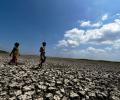
The onset of the southwest monsoon is being keenly watched this year as it may provide an early sign regarding its progress over the Indian subcontinent, particularly when El Nio is expected to rear its head during the latter half of the season.

Conditions were becoming favourable for further advance of the southwest monsoon over some more parts of the south peninsula and east India and adjoining areas between June 18 and 21.

There is increased risk for agriculture in India from the monsoon after drought ravaged the country in 2002, forecast the Summer Outlook report of Salomon Smith Barney made available Monday.

Many years during which monsoons were poor saw high returns, while normal or excess rainfall has also coincided with poor calendar year gains.

El Nino is expected to occur in August-September, but it is unlikely to have any major impact on the monsoon, and the weatherman expects a positive Indian Ocean Dipole, which has a strong influence on rainfall in the country.

While Maruti leads with 30% volume growth, Hyundai sold 18,337 vehicles in rural markets during April-June

The India Meteorological Department said the southwest monsoon further advanced into Delhi, Uttar Pradesh, Himachal Pradesh, Jammu and Kashmiri, some parts of Punjab, Haryana and Rajasthan on June 30.

Bhavnagar was also one of the worst affected districts, they said, adding that more downpour is likely over the next four day in parts of the state.

64 years after the Panshet Dam burst claimed 1,000 lives, the tragedy stands as both a haunting memory and a vital lesson in engineering caution.

A below-normal monsoon is likely to drag down the food output with India's agricultural GDP growth likely to slump to 0.8 pc in the current fiscal, says a report by the Japanese brokerage firm Nomura.
While weather forecasters remain divided on how the monsoons will play out in India over the next few months, analysts believe the news at the current juncture - at best - can trigger a knee-jerk reaction in the markets. They believe it is too early to say whether the sub-par monsoon on account of El Nino can seriously dent the market sentiment in the short-to-medium term. "These are just initial forecasts and we will have another round / status update from the weather forecasters a month down the line.

India recorded 125 extremely heavy rainfall events during September and October of 2021, the highest in five years, owing to late withdrawal of the southwest monsoon and higher-than-normal low-pressure systems, India Meteorological Department (IMD) said on Tuesday.

Cyclone 'Biparjoy', the first storm brewing in the Arabian Sea this year, has rapidly intensified into a severe cyclonic storm, with meteorologists predicting a 'mild' monsoon onset over Kerala and 'weak' progress beyond southern peninsular under its influence.

With the prediction of an above normal monsoon in 2024, the government is expecting food prices to come down, the finance ministry's monthly economic report for March has said. The report, released on Thursday, said robust foreign inflows and comfortable trade deficits were expected to keep the rupee within a comfortable range. "Further easing of food prices is on the anvil as IMD (India Meteorological Department) has predicted above-normal rainfall during the monsoon season, which is likely to lead to higher production, assuming good spatial and temporal distribution of the rainfall," the monthly report, released by the Department of Economic Affairs, said.

Pulses cropping has jumped to 39.4 per cent above 2015 levels.

Hundreds of people were shifted to relief camps from low-lying areas of Kerala as flood water entered their houses with monsoon rains gaining further strength in the state.
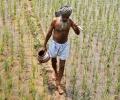
A prolonged break in monsoon rains in most parts of the country is threatening to hit the yield of kharif crops. It could even delay the upcoming rabi sowing. Major agricultural states, such as Maharashtra, Madhya Pradesh, Andhra Pradesh, Punjab, and Gujarat, have witnessed a deficit of 30-80 per cent in southwest monsoon rainfall in August compared to the long-period average for the month. Meteorologists see no big revival in monsoon rains from hereon, though they forecast "some activity" over the Bay of Bengal on September 5-6.

As heavy rains continue to lash Kerala, the India meteorological department on Friday issued an orange alert in eight districts in Kerala for Friday.

In another forecast for August, IMD Director General Mrutunjay Mohapatra said monsoon is also likely to be normal in the month.
It is essential to have a comprehensive motor policy, and not just a third-party cover, as the latter does not protect your own vehicle.

The IMD came out with a dismaying prediction.
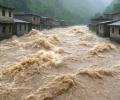
A devastating flashflood in the Kheer Ganga river on August 5 demolished nearly half of Dharali -- the key stopover en route to Gangotri with many hotels and homestays, and neighbouring Harsil, where an Army camp bore the brunt of the flood fury, barely giving time to the victims to run to safety.

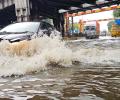
The Delhi government is likely to take disciplinary actions against officials responsible for waterlogging at the Minto Bridge underpass after overnight showers. A junior engineer and pump operator responsible for the underpass will be suspended and the assistant engineer will be issued a show cause notice for supervisory lapses.
India will receive normal monsoon this season, country's meteorological department said on Wednesday in its forecast for the Southwest monsoon that covers 75 per cent of the country, and thereby may bring much-needed respite to the economy, which is reeling under the catastrophic effect of the Covid-19 pandemic.

Contrary to some predictions, rainfall is adequate so far.

Climate change has hampered the ability of the forecasting agencies to accurately predict severe events and weather bureaus across the world are focusing on augmenting the observational network density and the weather prediction modelling to improve predictability, India Meteorological Department (IMD) Director General Mrutyunjay Mohapatra has said.

'The intensity and frequency of heatwaves will be much higher than in previous years over Punjab, Haryana, Rajasthan, Gujarat, Madhya Pradesh and Odisha.'

The meteorological centre in Shimla issued a 'red' alert on Sunday for very heavy downpour in 10 districts of Himachal Pradesh, while services on the Shimla-Kalka rail line were suspended for hours till the debris and trees fallen on the tracks following overnight rains were removed.

Reports said that in Telangana and Karnataka, excessive rains the past 10 days has threatened the standing green gram and maize crops and could negatively impact yields if the skies don't open up. But in the north-west and central parts of India, the resurgence of monsoon could not have come at a better time as oilseeds and pulses crops would otherwise had weathered if the rains didn't revive in August.

The city received about 104 mm of rainfall in the last 24 hours, inundating many low-lying areas and leading to traffic pile-up, prompting the BJP to launch a scathing attack on the ruling Congress.

The relief and rehabilitation measures were running in full swing with Chief Minister Nitish Kumar launching a drive under which over Rs 180 crore were disbursed among affected people through direct cash transfer.

Skymet says the IMD ignored the required criterion of two days of necessary rainfall to declare a proper onset of monsoon, reports Sanjeeb Mukherjee.

Moody's Ratings on Tuesday said India's growing water shortage can disrupt farm and industry sectors and is detrimental to the credit health of the sovereign as rising food inflation and decline in income may spark social unrest. It said decreases in water supply can disrupt agricultural production and industrial operations, resulting in inflation in food prices and hence can be detrimental to credit health of sectors that heavily consume water, such as coal power generators and steel-makers.
